Table of Contents
ToggleBackyard landscaping doesn’t require a six-figure budget or a landscape architect’s license. Many homeowners assume that creating an attractive outdoor space means hauling in tons of sod, planting high-maintenance ornamentals, or pouring concrete for elaborate hardscapes. The reality? Simple backyard landscaping ideas can transform a dull yard into a welcoming retreat with a little planning and some basic DIY effort. Whether you’re working with a small urban plot or sprawling suburban acreage, these practical projects deliver real impact without overcomplicating things.
Key Takeaways
- Simple backyard landscaping ideas don’t require a large budget—start with one or two foundational projects like pathways, patios, or native plantings to transform your outdoor space.
- Build durable hardscaping with recycled materials or pavers on a compacted gravel base, ensuring proper drainage by sloping patios away from your house to prevent settling and water damage.
- Native plants thrive in your region’s climate with minimal watering or maintenance; consult your local USDA Hardiness Zone and nursery staff to select shrubs and perennials suited to your soil.
- Raised garden beds solve poor soil and accessibility issues, costing $100–$300 to build from untreated cedar or composite lumber and providing excellent drainage for vegetables and herbs.
- Add shade structures, seating, and landscape lighting to create an inviting retreat; solar-powered lights and shade sails offer budget-friendly options that enhance both ambiance and safety.
- Design a focal point—such as a water feature, specimen plant, or sculptural shrub—positioned to draw the eye and give your yard intentional purpose without overwhelming the space.
Add Hardscaping With Low-Maintenance Pathways and Patios
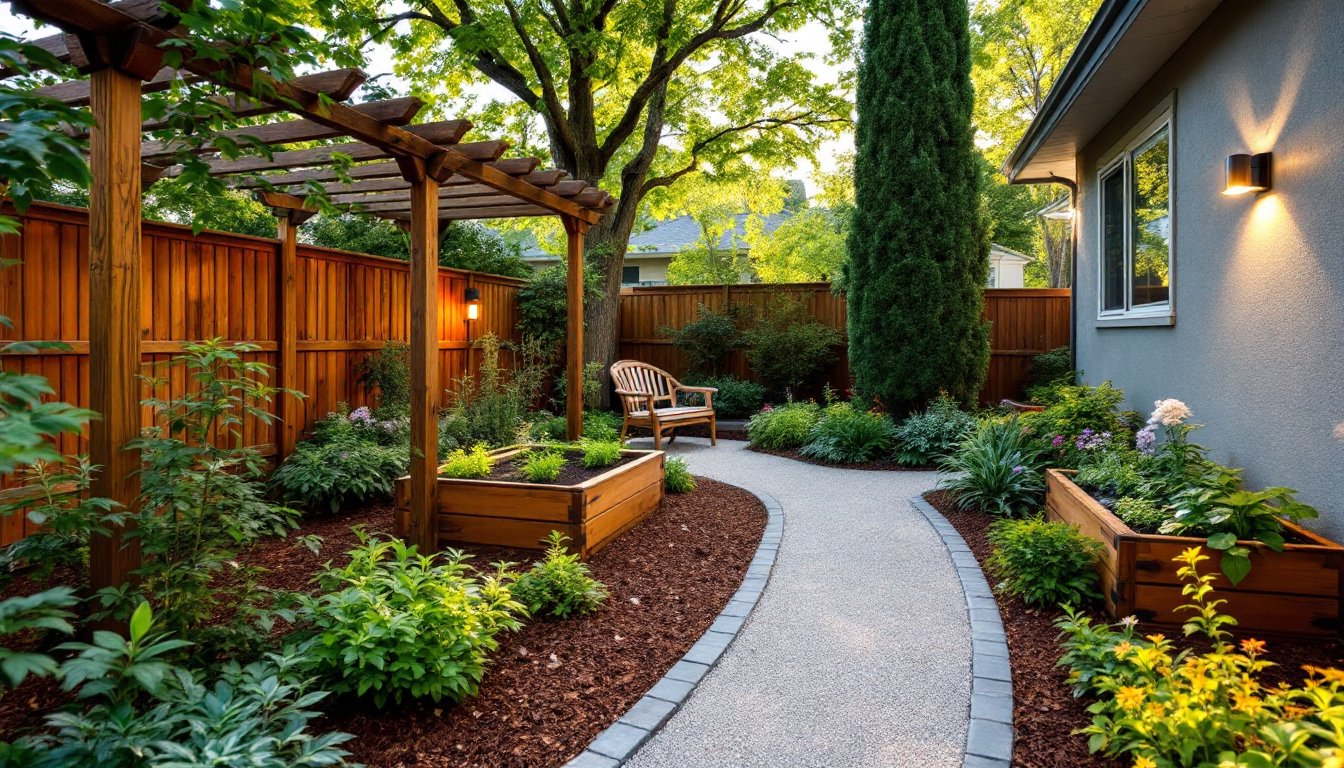
Hardscaping, the permanent structures and surfaces in your landscape, forms the skeleton of any outdoor space. Start with a simple pathway using recycled asphalt, decomposed granite, or mulch if budget is tight. For a more durable option, lay pavers or stepping stones in a sandy base about 1 to 2 inches deep. They’re easy to replace individually if one breaks, and you don’t need heavy machinery.
A small patio anchors the space and gives you a defined seating area. You can build one with concrete pavers (typically 12×12 or 16×16 inches), flagstone, or even recycled brick. Lay them on a compacted gravel base with sand joints, no mortar needed for a casual, more forgiving finish. This approach takes a weekend and minimal tools: a level, rubber mallet, and a hand tamper.
Before you start, mark out your pathway or patio with string and stakes. Rough ground and weeds won’t disappear under new material, remove them first. Missing this step guarantees uneven surfaces and settling within a year. A low-maintenance hardscape also requires proper drainage: slope patios slightly away from the house (about 1/8 inch per foot) to shed water.
Choose Native Plants and Shrubs for Effortless Curb Appeal
Native plants thrive in your region’s climate without fussing over watering schedules or special fertilizers. Before planting, identify your hardiness zone (check the USDA Hardiness Zone Map online) and soil type, clay, sandy, or loamy all suit different species.
Visit local nurseries and ask which shrubs, perennials, and groundcovers do well locally. A butterfly bush, serviceberry, or viburnum typically performs well across temperate zones and requires minimal pruning. Pair them with simple backyard landscaping ideas that emphasize seasonal interest, flowering in spring, texture in summer, and persistent seed heads or berries in fall.
Plant in autumn or early spring when soil is workable. Dig a hole as deep as the root ball and twice as wide: this encourages roots to spread laterally. Water deeply after planting, then mulch with 2 to 3 inches of shredded bark or compost, not touching the stem. Mulch suppresses weeds and retains moisture, cutting irrigation needs in half. Most established natives need supplemental water only during severe drought.
Install Raised Garden Beds for Fresh Produce and Design Impact
Raised beds solve two problems: poor native soil and bad backs from bending. A 4-foot by 8-foot by 12-inch bed holds about 32 cubic feet of soil, plenty for vegetables, herbs, or ornamental plants.
Build the frame from untreated cedar, composite lumber, or galvanized steel. Cedar is rot-resistant and looks polished: untreated pine works too but lasts 5 to 7 years. Avoid pressure-treated lumber if you’re growing vegetables (the preservatives have improved over decades, but untreated remains safer for edible gardens). Assemble with exterior-grade screws, not nails, which loosen over time.
Place your bed on level ground and, if the underlying soil is compacted clay, loosen it first with a broadfork or shovel. This prevents a bathtub effect where water pools. Fill with a blend: compost, peat moss or coconut coir, and coarse perlite or sand in roughly equal parts. This mix drains well yet retains moisture. A raised bed ready to plant costs $100 to $300 depending on materials and size, far less than replacing soil across your whole yard. Garden Path Ideas pair beautifully alongside beds to create structure.
Create Shade and Seating With Simple Outdoor Structures
A pergola, shade sail, or arbor transforms a sun-blasted yard into a livable retreat and anchors your landscape visually. A basic freestanding arbor (4 feet wide, 7 feet tall) requires four 4×4 posts, cross beams, and lattice panels. Set posts in concrete footings dug 18 to 24 inches deep, frost heave will topple a structure set on soil alone. Check your local frost line depth, which varies by region.
For a lower-skill option, a shade sail is a tensioned fabric anchored to posts or walls. It requires fewer materials and bolts together in a day. Position it to block afternoon sun while allowing morning light.
Add a bench or simple seating, either anchored to a deck or free-standing. A basic wooden bench with a backrest costs $150 to $400 to build or buy. Paint or stain it with exterior-grade finish rated for UV exposure to prevent checking and fading. Garden Ideas often incorporate seating as focal points, turning utility into design.
Incorporate Landscape Lighting for Ambiance and Safety
Low-voltage landscape lighting costs a fraction of line-voltage wiring and poses no shock hazard. A solar-powered system is the easiest entry point: LED spotlights, stake lights, or uplights charge during the day and illuminate pathways, plants, or accent features at night. They require zero wiring and no permit.
If you want more control, a low-voltage transformer (12 or 24 volts) plugged into an outdoor outlet powers hardwired lights on buried cable. This approach costs more upfront but allows you to dim, schedule, and zone lighting. Install cable in shallow trenches or PVC conduit to protect it from shovel strikes.
Safety takes priority: light pathways and steps brightly enough to prevent trips. A lumens rating of 50 to 100 per fixture suits most residential pathways. Ambiance lighting, uplighting trees or highlighting a water feature, can run dimmer. Avoid glare pointing directly at eyes. Modern landscape lighting often uses smart controls and daylight sensors to reduce manual switching and energy waste. Solar options reduce electricity costs and suit renters or areas without convenient outlets.
Design a Focal Point With Water Features or Statement Landscaping
A focal point draws the eye and gives the landscape purpose. A small fountain, birdbath, or water feature doesn’t require a full pond or waterfall. A self-contained fountain in a decorative basin (18 to 36 inches wide) sits anywhere, even a small apartment balcony, and recirculates water via a submersible pump. Cost runs $100 to $500 depending on material and size.
Alternatively, create focal interest with a specimen plant, a sculptural shrub, ornamental tree, or dramatic perennial positioned where it catches attention entering the yard. An olive tree, Japanese maple, or columnar evergreen serves as a living artwork. Pool Landscaping demonstrates how focal points anchor larger spaces, though your feature needn’t be aquatic.
Group plantings in odd numbers (three, five, or seven plants) rather than pairs, this looks more natural and sophisticated. Vary height, color, and texture among plants to sustain visual interest. A focal point prevents “visual noise” from random plantings and gives guests a reason to linger. It’s the difference between a yard and an intentional outdoor room.
Conclusion
Building a welcoming backyard doesn’t demand perfection or a bloated budget. Start with one or two projects, maybe a small patio and native shrubs, or a raised bed and simple pathway. These foundational moves create structure and momentum. Layer in seating, lighting, and a focal point over time as your vision clarifies. Mistakes in landscape design are cheap compared to structural home repairs: if something isn’t working, rearrange it. Commercial Landscaping principles, scale, proportion, and focal hierarchy, apply to residential yards too. Your outdoor space is an extension of your home and an investment in daily well-being. With these simple backyard landscaping ideas and a little elbow grease, you’ll enjoy a transformed retreat for years to come.